Compare a tummy tuck vs. liposuction to understand the differences in procedure, results, recovery time, benefits, and risks. Learn which option may be more suitable for removing excess fat, addressing loose skin, and achieving your body-contouring goals.
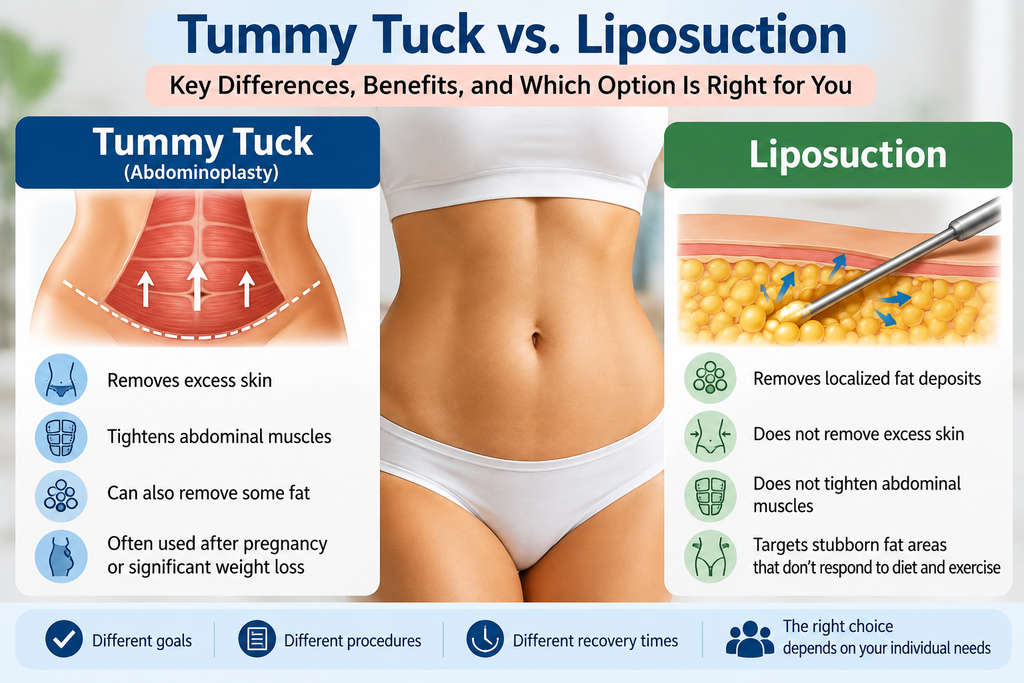
A tummy tuck and liposuction are both surgical body-contouring procedures, but they address different concerns. Liposuction removes localized pockets of fat, while a tummy tuck (abdominoplasty) removes excess abdominal skin and fat and can tighten weakened or separated abdominal muscles.
The two procedures can sometimes be performed together, but the appropriate option depends on factors such as the amount of excess fat, loose skin, skin elasticity, abdominal muscle laxity, overall health, and your cosmetic goals. Neither procedure is designed to replace healthy weight management.
In this guide, we’ll explain the key differences between a tummy tuck and liposuction, what each procedure can and cannot address, recovery considerations, potential risks, and why some people may have both procedures.
What Is a Tummy Tuck?
A tummy tuck, medically known as abdominoplasty, is a surgical procedure that changes the shape and appearance of the abdomen.
During a typical tummy tuck, a surgeon removes excess skin and fat from the abdomen and tightens the underlying connective tissue. When the abdominal muscles have separated, the procedure may also bring those muscles back together. The remaining skin is then repositioned to create a smoother abdominal contour.
People can develop excess abdominal skin or weakened abdominal tissues for several reasons, including:
- Significant weight changes
- Pregnancy
- Aging
- Previous abdominal surgery
- Individual body structure
A tummy tuck can therefore address more than a pocket of fat. It may be considered when loose skin or abdominal laxity is an important part of the person’s concern.
However, a tummy tuck is not appropriate for everyone. Mayo Clinic notes that people planning substantial weight loss, people who may become pregnant, and people with certain health or healing risks may be advised to postpone or reconsider the procedure.
What Is Liposuction?
Liposuction is a surgical body-contouring procedure used to remove localized deposits of fat.
A surgeon uses a thin tube called a cannula to loosen and suction fat from selected areas. Liposuction can be used on areas such as the abdomen, waist, hips, thighs, back, arms, and other parts of the body.
Liposuction is generally intended for people who have specific areas of excess fat that do not respond as desired to diet and exercise. It is not intended as a substitute for weight management or as a treatment for obesity.
One important limitation is skin quality. After fat is removed, the skin needs to adapt to the new underlying contour. People with good skin elasticity may have smoother results, while thin or less-elastic skin may remain loose after liposuction.
This is one of the major reasons why liposuction and a tummy tuck are not interchangeable procedures.
Tummy Tuck vs. Liposuction: What’s the Main Difference?
Although both procedures can improve the appearance of the abdomen, a tummy tuck and liposuction address different concerns.
Liposuction primarily removes localized fat, while a tummy tuck can remove excess abdominal skin and fat and address weakened or separated abdominal muscles when appropriate.
Liposuction primarily addresses localized fat
Liposuction is designed to remove deposits of fat beneath the skin. It may be considered when someone has localized areas of fat that remain despite maintaining a healthy lifestyle.
However, liposuction does not remove significant amounts of loose skin or repair separated abdominal muscles.
A tummy tuck addresses excess skin and abdominal laxity
A tummy tuck can remove excess abdominal skin and may tighten the underlying abdominal wall when muscle separation or laxity is present.
This can make it more relevant for someone who has significant loose skin after pregnancy or substantial weight loss.
The two procedures can sometimes complement each other
Some people have both excess fat and loose skin. In such situations, a surgeon may determine that combining liposuction with a tummy tuck could address both concerns.
However, combining procedures is not appropriate for everyone and depends on the individual’s health, anatomy, goals, and surgical risk.
Which one is right for you?
There is no universal answer to whether a tummy tuck or liposuction is better.
If localized fat is the primary concern and the skin has adequate elasticity, liposuction may be considered.
If significant loose skin or abdominal muscle laxity is the main concern, a tummy tuck may be more appropriate.
A qualified plastic surgeon can evaluate your abdomen and discuss which approach is most suitable for your individual circumstances.
What Does a Tummy Tuck Treat?
A tummy tuck may be considered when the main concern involves excess abdominal skin, tissue laxity, or weakened abdominal muscles, rather than simply a localized pocket of fat.
Excess Abdominal Skin
Significant weight loss, pregnancy, aging, and major changes in body size can leave excess skin around the abdomen. This skin may not disappear through diet and exercise alone.
During a tummy tuck, the surgeon can remove excess skin and reposition the remaining skin to create a smoother abdominal contour.
Abdominal Muscle Separation
Pregnancy can stretch and separate the abdominal muscles. A tummy tuck may allow the surgeon to repair or tighten the abdominal wall when this is appropriate.
This is an important distinction because liposuction cannot repair separated abdominal muscles.
Excess Abdominal Tissue After Weight Loss
People who lose a substantial amount of weight may be left with a combination of loose skin and remaining abdominal fat.
In these situations, removing fat alone may not address the excess skin. A tummy tuck may be considered when loose abdominal skin is a significant part of the concern.
What a Tummy Tuck Does Not Do
A tummy tuck is not a weight-loss procedure. It is intended to reshape the abdomen rather than treat obesity.
It also cannot prevent future changes caused by significant weight gain, weight loss, or pregnancy.
For people considering the procedure, maintaining a relatively stable weight and discussing future pregnancy plans with a qualified surgeon are important considerations.
What Does Liposuction Treat?
Liposuction is primarily used to remove localized deposits of fat and improve the shape or contour of specific areas of the body. It is not intended to treat overall obesity or replace healthy weight management.
Localized Fat Deposits
Some people have areas of fat that remain even when they maintain a healthy diet and regular physical activity. Liposuction can be used to remove fat from selected areas when appropriate.
Common treatment areas include:
- Abdomen
- Waist and hips
- Thighs
- Upper arms
- Back
- Buttocks
- Neck and chin
The specific areas that can be treated depend on the individual’s anatomy, health, and treatment goals.
Liposuction and Belly Fat
Liposuction can remove subcutaneous fat, which is the fat located underneath the skin.
However, it does not remove visceral fat, which is stored deeper inside the abdomen around internal organs. This distinction is important because visceral fat is associated with metabolic and cardiovascular health risks and cannot be treated through cosmetic liposuction.
Liposuction Does Not Remove Significant Loose Skin
One of the biggest limitations of liposuction is that it is primarily a fat-removal procedure.
After fat is removed, the skin needs to adapt to the new underlying contour. People with good skin elasticity may experience some natural skin contraction, but significant loose skin may remain.
When excess skin is a major concern, a tummy tuck or another appropriate body-contouring procedure may be considered instead.
Liposuction Is Not a Weight-Loss Procedure
Although removing fat can change the appearance of a treated area, liposuction should not be viewed as a method for losing a large amount of body weight.
It is generally intended for body contouring and localized fat reduction, rather than treating obesity.
When Liposuction May Not Be Enough
If someone has both significant localized fat and substantial loose abdominal skin, liposuction alone may not produce the desired contour.
This is one reason a surgeon may evaluate whether a tummy tuck, liposuction, or a combination of procedures would better address the person’s concerns.
Tummy Tuck vs. Liposuction After Weight Loss
Significant weight loss can change the shape and appearance of the abdomen, but losing weight does not always eliminate every concern in this area. Some people are left with excess skin, localized fat, weakened abdominal tissues, or a combination of these changes.
This is where the difference between a tummy tuck and liposuction becomes particularly important.
Excess Skin After Weight Loss
When the skin has been stretched for a long period, it may not completely tighten after substantial weight loss. The result can be folds or hanging skin around the abdomen.
Liposuction does not remove this excess skin. Removing additional fat may sometimes make loose skin more noticeable if the skin cannot contract sufficiently.
A tummy tuck, on the other hand, can remove excess abdominal skin and reshape the remaining tissue.
Remaining Localized Fat
Even after reaching a relatively stable weight, some people may have localized deposits of fat around the abdomen or waist.
If the primary concern is this type of localized fat and the skin has adequate elasticity, liposuction may be considered.
However, if significant loose skin is also present, liposuction alone may not address the overall appearance.
When Both Problems Are Present
Some people who have lost substantial weight have both excess skin and localized fat.
In selected cases, a surgeon may recommend a combination of procedures to address different aspects of the abdominal contour. The appropriate approach depends on the person’s health, anatomy, amount of excess tissue, and goals.
Why Stable Weight Matters
People considering body-contouring surgery after weight loss are generally advised to reach a relatively stable weight before undergoing the procedure.
Major weight changes after surgery can alter the result and may lead to additional changes in the treated area.
For this reason, body contouring is usually considered after the major phase of weight loss has been completed rather than while someone is actively losing substantial amounts of weight.
What Should You Expect After Weight Loss?
There is no single procedure that is right for everyone.
If loose skin is the dominant concern, a tummy tuck may be more appropriate.
If localized fat is the dominant concern and skin elasticity is adequate, liposuction may be considered.
If both are significant concerns, a qualified plastic surgeon can determine whether one procedure or a combination would be appropriate.
Can Liposuction Tighten Loose Skin?
This is one of the most important differences between liposuction and a tummy tuck.
Liposuction removes fat, but it does not remove significant amounts of excess skin. After fat is removed, the remaining skin must contract and adapt to the new underlying contour. How well this happens depends partly on the individual’s skin elasticity.
What Happens to the Skin After Liposuction?
When fat is removed, the skin may naturally contract to some degree. People with relatively good skin elasticity may experience a smoother contour after the procedure.
However, skin that has been significantly stretched may not contract enough to eliminate loose or hanging tissue.
Factors that can affect skin elasticity include:
- Age
- Genetics
- The degree to which the skin has been stretched
- Significant previous weight loss
- Pregnancy
- The quality and elasticity of the skin
Because individual responses vary, a surgeon needs to assess the skin before determining whether liposuction alone is likely to produce the desired result.
What If You Have Significant Loose Skin?
When excess skin is a major concern, simply removing more fat may not solve the problem.
A tummy tuck can address significant excess abdominal skin by surgically removing the unwanted tissue and repositioning the remaining skin. It may also address abdominal muscle laxity when appropriate.
This is particularly relevant for people who have lost a substantial amount of weight and are left with loose abdominal skin.
Why the Difference Matters
Someone with a relatively firm abdomen and a localized pocket of fat may be a candidate for liposuction.
Someone with significant loose skin may need a different body-contouring approach.
In some cases, both excess fat and excess skin are present, and a surgeon may consider combining procedures to address both concerns.
The key point: liposuction is primarily a fat-removal procedure, while a tummy tuck can address excess abdominal skin and abdominal wall laxity.
Can a Tummy Tuck Remove Belly Fat?
A tummy tuck can remove some excess fat from the abdominal area, but fat removal is not the main purpose of the procedure.
The primary goals of a tummy tuck are to remove excess abdominal skin, reshape the abdominal area, and, when appropriate, address weakened or separated abdominal muscles.
How Much Fat Can a Tummy Tuck Remove?
The amount of fat removed during a tummy tuck varies from person to person and depends on the surgical approach and the individual’s anatomy.
A tummy tuck should not be viewed as an alternative to liposuction when the primary concern is localized fat.
If a person has substantial localized fat deposits, the surgeon may evaluate whether liposuction or another approach would be more appropriate.
Tummy Tuck vs. Liposuction for Belly Fat
If the main concern is localized abdominal fat with relatively good skin elasticity, liposuction may be considered.
If the person has significant loose skin along with abdominal fat, a tummy tuck may be more appropriate because it can address the excess skin as well as reshape the abdominal area.
In some cases, surgeons may combine liposuction with a tummy tuck to address both localized fat and excess skin. Whether this is appropriate depends on the individual’s health, anatomy and treatment goals.
Neither Procedure Removes Visceral Fat
It’s also important to distinguish cosmetic abdominal fat from visceral fat.
Visceral fat is stored deep inside the abdomen around internal organs. Tummy tuck and liposuction are not treatments for visceral fat or the health conditions associated with excess visceral fat.
This means that even after cosmetic body contouring, maintaining a healthy body weight, eating a balanced diet and staying physically active remain important.
Can You Have a Tummy Tuck and Liposuction Together?
Yes. In some situations, a tummy tuck and liposuction may be performed during the same surgical procedure.
The reason is that the two procedures address different aspects of body contouring. A tummy tuck can remove excess abdominal skin and address abdominal muscle laxity when appropriate, while liposuction can remove localized deposits of fat.
Why Might They Be Combined?
Someone may have both excess abdominal skin and localized fat. Treating only one of these concerns may not produce the desired overall contour.
For example, a person who has lost a substantial amount of weight may have loose abdominal skin as well as remaining fat around the abdomen or waist. A surgeon may determine that combining procedures could address both concerns.
Does Everyone Need Both Procedures?
No.
Combining a tummy tuck with liposuction is not automatically better than having one procedure alone. The decision depends on the person’s:
- Overall health
- Amount and location of excess fat
- Amount of loose skin
- Skin elasticity
- Abdominal muscle condition
- Weight stability
- Cosmetic goals
- Individual surgical risks
A qualified plastic surgeon should determine whether combining the procedures is appropriate after evaluating the individual.
Are There Additional Risks When Procedures Are Combined?
Combining surgical procedures can increase the extent of the operation and may affect recovery and complication risk.
For that reason, the decision should be based on an individualized medical assessment rather than simply choosing the combination because it may produce more extensive contouring.
The surgeon should explain the expected benefits, limitations, recovery requirements and potential complications before surgery.
Which Procedure Has a Longer Recovery?
Both a tummy tuck and liposuction require recovery because they are surgical procedures. However, a tummy tuck generally involves a more extensive recovery than liposuction, because it can involve removal of excess skin and work on the abdominal wall in addition to any fat removal.
The exact recovery time varies depending on the extent of the procedure, the person’s health, whether procedures are combined, and the type of work or activity they normally perform.
Tummy Tuck Recovery
Recovery from a tummy tuck can involve several weeks of restricted activity.
After surgery, patients may experience:
- Swelling
- Bruising
- Discomfort or pain
- Temporary changes in sensation
- Tightness around the abdomen
- Restrictions on lifting and strenuous activity
Mayo Clinic notes that many people return to work approximately 2 to 4 weeks after a tummy tuck, although recovery varies and people with physically demanding jobs may need more time. Full recovery can take longer.
Liposuction Recovery
Liposuction recovery can also involve swelling, bruising, soreness and temporary numbness.
Some people can return to work within days or weeks, depending on the extent of treatment and the nature of their job. However, swelling can take considerably longer to settle, and the final contour may not be apparent immediately.
Mayo Clinic notes that the treated areas may take several weeks or months to fully settle as swelling decreases.
Which Recovery Is More Extensive?
In general, tummy tuck recovery is more extensive than recovery from liposuction alone because the procedure involves more substantial tissue changes.
However, recovery is highly individual. Someone having extensive liposuction may have a different recovery experience from someone undergoing a smaller procedure.
If tummy tuck and liposuction are performed together, recovery will reflect the combined procedure rather than liposuction alone.
Following Your Surgeon’s Recovery Instructions
Recovery instructions can differ depending on the procedure and the individual’s circumstances.
Patients should follow their surgeon’s instructions regarding:
- Wound care
- Physical activity
- Lifting
- Driving
- Compression garments, when recommended
- Returning to work
- Follow-up appointments
Trying to return to strenuous activity too quickly can interfere with recovery.
What Are the Risks and Potential Complications?
Tummy tuck and liposuction are surgical procedures, so both involve potential risks. The risks vary depending on the procedure, the amount of tissue being treated, the individual’s health, and whether multiple procedures are performed at the same time.
A consultation with a qualified plastic surgeon is important for understanding the risks that apply to you specifically.
Tummy Tuck Risks
Potential complications of a tummy tuck can include:
- Bleeding
- Infection
- Fluid accumulation under the skin
- Poor wound healing
- Noticeable or unfavorable scarring
- Changes in skin sensation or numbness
- Skin or tissue damage
- Persistent pain
- Blood clots
- Reactions to anesthesia
Some complications may require additional treatment or, in certain cases, further surgery.
Liposuction Risks
Liposuction also carries potential complications, including:
- Bleeding
- Infection
- Swelling and bruising
- Temporary or persistent numbness
- Contour irregularities
- Fluid accumulation
- Skin changes
- Damage to deeper structures
- Blood clots
- Fat embolism
- Reactions to anesthesia
The risk can increase with larger treatment areas or when multiple procedures are performed together.
Scarring
Scarring is an important consideration with a tummy tuck.
Because excess skin is surgically removed, a tummy tuck generally produces a more substantial scar than liposuction. The appearance of the scar can change over time, but it does not completely disappear.
Liposuction generally involves smaller incisions, although the resulting scars can still vary between individuals.
Blood Clots and Other Serious Complications
Although uncommon, serious complications such as blood clots can occur with surgical procedures.
The risk may depend on factors such as the person’s health, the length and extent of the operation, and whether multiple procedures are combined.
This is one reason a surgeon should review your medical history, medications, previous surgeries and other relevant factors before recommending a procedure.
When Should You Contact Your Surgeon?
After surgery, patients should follow their surgeon’s instructions regarding warning signs and when to seek medical attention.
Symptoms such as severe or worsening pain, significant bleeding, difficulty breathing, chest pain, or other concerning changes should receive prompt medical attention.
Who May Be a Candidate for Each Procedure?
Being interested in body contouring does not automatically mean that a tummy tuck or liposuction is appropriate. A surgeon considers the person’s overall health, body composition, skin quality, medical history and expectations before recommending a procedure.
Who May Be a Candidate for Liposuction?
Liposuction may be considered for people who have localized deposits of fat that they would like to reduce and who are otherwise in reasonably good health.
Candidates may have:
- Relatively stable body weight
- Localized areas of excess fat
- Reasonable skin elasticity
- Realistic expectations about what the procedure can achieve
- No medical conditions that would make surgery unnecessarily risky
Liposuction is generally not intended as a treatment for obesity or as a substitute for weight loss.
Who May Be a Candidate for a Tummy Tuck?
A tummy tuck may be considered when a person has excess abdominal skin, abdominal tissue laxity, or weakened or separated abdominal muscles.
This may occur after:
- Significant weight loss
- Pregnancy
- Major changes in body weight
- Aging
- Previous abdominal changes or surgery
Mayo Clinic notes that people considering a tummy tuck should generally be in good overall health and have realistic expectations. People planning significant weight loss or future pregnancy may be advised to postpone the procedure.
What About People Who Have Both Excess Fat and Loose Skin?
Some people have both problems.
For example, someone who has lost a significant amount of weight may have loose abdominal skin along with remaining localized fat.
In such cases, a surgeon may consider whether a tummy tuck, liposuction, or a combination of procedures would best address the person’s concerns.
Why Your Health Matters
Both procedures involve surgery, so overall health and individual risk factors matter.
Before surgery, your healthcare team may consider factors such as:
- Medical conditions
- Previous operations
- Medications
- Smoking
- Weight stability
- Ability to heal properly
- Future pregnancy plans
- Previous complications with anesthesia or surgery
A proper medical evaluation is therefore more important than simply choosing a procedure based on photographs or online descriptions.
Realistic Expectations Are Important
Even when someone is medically suitable for surgery, the expected result needs to be realistic.
Neither liposuction nor a tummy tuck can guarantee a particular appearance, and both procedures have limitations and potential complications.
The goal should be to understand what the procedure can realistically accomplish for your individual body, rather than expecting it to produce a specific result seen in another person.
What Should You Consider Before Choosing?
Choosing between a tummy tuck and liposuction should not be based solely on the amount of fat you want to remove. The two procedures address different concerns, and the most appropriate option depends on your body, health, expectations, and goals.
1. Identify Your Main Concern
Start by considering what you actually want to change.
If your main concern is localized fat, liposuction may be worth discussing with a qualified surgeon.
If your main concern is significant loose abdominal skin, a tummy tuck may be more appropriate.
If you have both excess fat and loose skin, your surgeon may discuss whether a combination of procedures could address both concerns.
2. Consider Your Weight Stability
Body-contouring surgery is generally better considered when your weight is relatively stable.
Significant weight loss or weight gain after surgery can change the appearance of the treated area and affect your results.
If you are still planning to lose a substantial amount of weight, discuss your timing with your healthcare provider before considering surgery.
3. Think About Future Pregnancy
If you are considering a tummy tuck and may become pregnant in the future, discuss this with your surgeon.
Pregnancy can stretch the abdominal tissues again and may alter the results of a previous tummy tuck. Mayo Clinic specifically recommends discussing future pregnancy plans with your healthcare provider.
4. Understand the Recovery
Neither procedure is completely risk-free or recovery-free.
Consider whether you can accommodate:
- Time away from work
- Restrictions on physical activity
- Follow-up appointments
- Wound care
- Temporary swelling and discomfort
- Restrictions on lifting and strenuous exercise
A tummy tuck generally involves a more extensive recovery than liposuction alone.
5. Understand the Scarring
A tummy tuck requires a surgical incision and therefore produces a more substantial scar.
Liposuction usually involves much smaller incisions, although scars can still occur.
Ask your surgeon where the incisions will be placed and what type of scarring you might reasonably expect.
6. Consider the Risks
Ask your surgeon to explain the potential complications specific to your situation.
Your personal medical history, medications, smoking status, previous surgeries, and other factors can influence surgical risk.
Don’t choose a procedure simply because it appears less invasive or produces attractive results in photographs.
7. Choose a Qualified Surgeon
Perhaps the most important consideration is who performs the procedure.
Look for a properly qualified, experienced plastic surgeon who can assess your individual anatomy and explain both the benefits and limitations of the procedure.
During your consultation, ask about the surgeon’s qualifications, experience with the procedure, expected results, recovery, complications, and what happens if you are not satisfied with the outcome.
8. Have Realistic Expectations
Neither procedure can guarantee a perfect or permanent appearance.
Body contouring can change the shape of treated areas, but normal aging, pregnancy and significant changes in body weight can affect the results over time.
The goal should be a realistic improvement that is appropriate for your individual body, rather than trying to reproduce someone else’s result.
If you are considering alternatives to surgery, non-surgical body contouring may be another option for addressing certain localized areas of fat, although the results and limitations differ from surgical procedures.
Frequently Asked Questions
Is a tummy tuck the same as liposuction?
No. They are different surgical procedures. Liposuction primarily removes localized fat, while a tummy tuck can remove excess abdominal skin and address abdominal muscle laxity when appropriate.
Which is better for belly fat: tummy tuck or liposuction?
It depends on what is causing the abdominal appearance. If the main concern is localized fat with relatively good skin elasticity, liposuction may be considered. If significant loose skin is also present, a tummy tuck may be more appropriate.
Does liposuction remove loose skin?
No. Liposuction removes fat rather than significant amounts of excess skin. The remaining skin may contract to some degree, but the amount of contraction varies between individuals.
Does a tummy tuck remove belly fat?
A tummy tuck can remove some abdominal fat along with excess skin, but its primary purpose is to reshape the abdomen and address excess skin and abdominal laxity. It is not a substitute for liposuction or a weight-loss treatment.
Can you have a tummy tuck and liposuction together?
Yes. In selected patients, surgeons may combine the two procedures to address both excess skin and localized fat. Whether this is appropriate depends on the person’s health, anatomy, goals and surgical risk.
Which has a longer recovery: tummy tuck or liposuction?
A tummy tuck generally involves a more extensive recovery than liposuction alone because it can involve removal of excess skin and work on the abdominal wall. However, recovery varies depending on the extent of treatment and the individual.
Is liposuction a weight-loss procedure?
No. Liposuction is primarily a body-contouring procedure designed to remove localized fat deposits. It is not intended to treat obesity or replace healthy weight management.
Can a tummy tuck help after major weight loss?
Yes. A tummy tuck may be considered when significant weight loss has left a person with excess abdominal skin or abdominal tissue laxity. Liposuction may also be considered if localized fat remains and the person is otherwise an appropriate candidate.
Can liposuction remove visceral fat?
No. Liposuction targets subcutaneous fat, which is located beneath the skin. It does not remove visceral fat located deeper inside the abdomen around internal organs.
Are tummy tuck and liposuction results permanent?
The fat cells removed during liposuction are permanently removed from the treated area, but remaining fat cells can enlarge with significant weight gain. Similarly, a tummy tuck can produce long-lasting changes, but pregnancy, aging and major weight changes can alter the result over time.
Is a tummy tuck safer than liposuction?
Neither procedure can be described as universally safer. Both are surgeries with potential risks, and the level of risk depends on the procedure, the extent of treatment and the individual’s health.
A qualified surgeon should assess your personal circumstances before recommending either procedure.
Bottom Line
A tummy tuck and liposuction are not interchangeable procedures.
Liposuction is primarily designed to remove localized deposits of fat, while a tummy tuck can remove excess abdominal skin and address abdominal muscle laxity when appropriate.
For someone with localized fat and relatively good skin elasticity, liposuction may be an option. For someone with substantial loose abdominal skin, particularly after pregnancy or significant weight loss, a tummy tuck may be more appropriate. Some people may benefit from a combination of the procedures.
Neither procedure is intended to replace healthy weight management, and both involve surgical risks and recovery.
The best choice depends on your individual anatomy, health, goals and expectations. A consultation with a qualified plastic surgeon can help determine which approach, if any, is appropriate.
References
Mayo Clinic — Tummy tuck (abdominoplasty)
Mayo Clinic — Liposuction
American Society of Plastic Surgeons — Liposuction
American Society of Plastic Surgeons — What is it like to get a tummy tuck?
American Society of Plastic Surgeons — Should you add liposuction to your tummy tuck?