A weight loss plateau occurs when weight loss slows down or stops despite continued efforts. Discover why this happens and which evidence-based lifestyle changes may help you make progress again.
You’ve been eating more carefully, exercising regularly, and watching your weight gradually decrease. Then something frustrating happens: the number on the scale stops moving.
You may wonder whether you’re doing something wrong or whether your metabolism has somehow “stopped working.”
The good news is that a period of slower or stalled weight loss is common. As your body weight changes, your energy needs can change too, and factors such as food intake, physical activity, appetite, sleep, and everyday movement can influence your progress.
But not every few days without a lower number on the scale is a true weight-loss plateau.
Here’s how to tell the difference—and what you can realistically do about it.
What Is a Weight-Loss Plateau?
A weight-loss plateau is a period during a weight-loss attempt when your body weight stops decreasing despite continuing with your current approach.
Plateaus are a normal part of many weight-loss journeys. Mayo Clinic explains that weight loss commonly slows or stalls because the body changes as weight is lost.
Early in a diet, weight can sometimes fall relatively quickly because the body uses stored glycogen, which is associated with water. As that initial water loss ends, the rate of weight loss naturally slows.
Later, losing body mass can also reduce the amount of energy your body needs each day. If your current calorie intake and energy expenditure eventually reach a new balance, your weight may stop falling.
A plateau therefore doesn’t necessarily mean that you’ve failed. It may simply mean that your current approach is no longer producing the same energy deficit that it did earlier.
If you’re eating healthy and exercising but still struggling to lose weight, our guide Why Am I Not Losing Weight Even Though I Eat Healthy and Exercise? explains some of the common reasons this can happen.
Is It Really a Weight-Loss Plateau?
Before changing your diet or exercise routine, make sure you’ve actually reached a plateau.
Body weight can change from day to day because of factors such as water retention, food in your digestive system, carbohydrate intake, sodium intake, and other normal fluctuations.
A few days of unchanged weight doesn’t necessarily mean that fat loss has stopped.
Instead of focusing on a single weigh-in, look at your weight trend over several weeks. Consistent measurements taken under similar conditions can give you a much clearer picture of what’s happening.
You may also notice progress in ways the scale doesn’t capture, such as changes in waist circumference, clothing fit, strength, or physical fitness.
Why Does Weight Loss Stop?
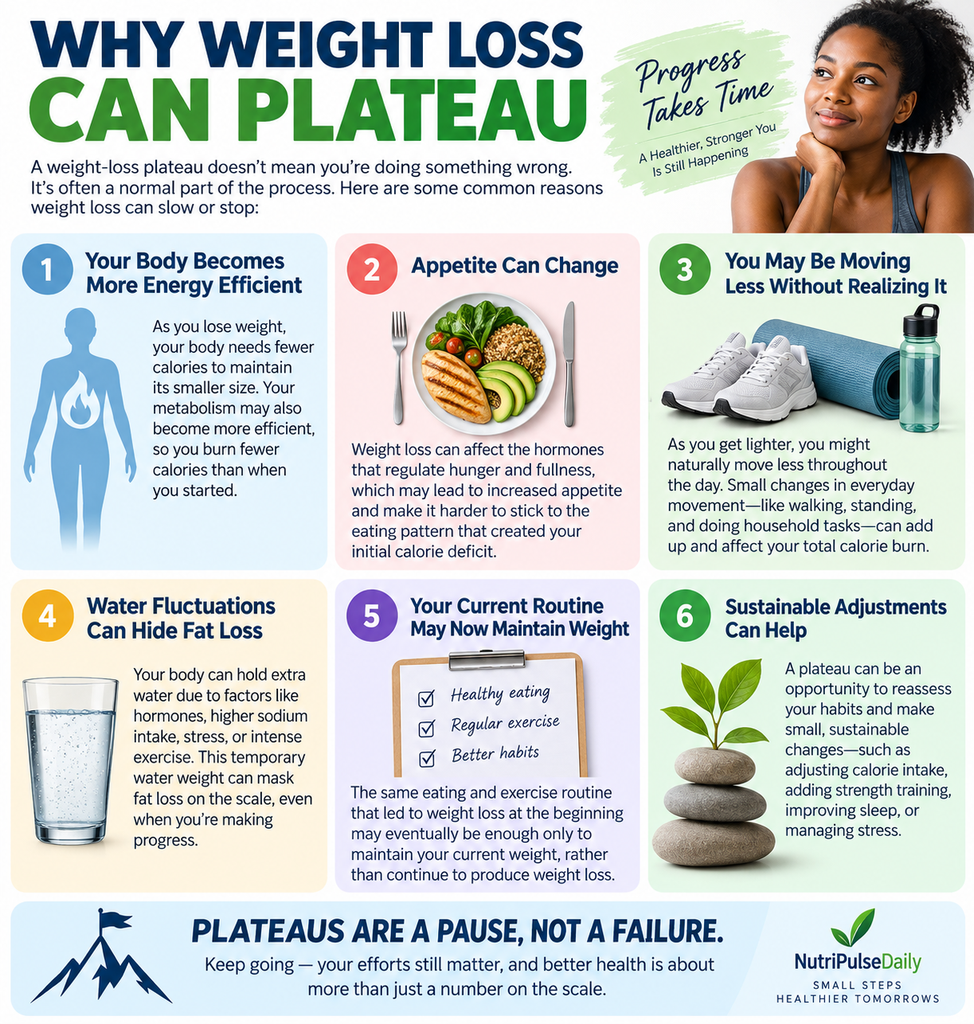
Your Body Now Needs Fewer Calories
As you lose weight, your body generally requires less energy to maintain its smaller size. You may therefore burn fewer calories than you did when you started.
Mayo Clinic explains that as weight decreases, metabolism can also decrease, contributing to a slowdown in weight loss.
This means that the same eating and exercise routine that produced weight loss at the beginning may eventually be enough only to maintain your new weight.
Your Appetite May Change
Weight loss can also affect appetite and make it harder to maintain the eating pattern that produced your original calorie deficit.
This is one reason long-term weight management isn’t simply a matter of willpower. Biological and behavioral factors can influence how difficult it is to maintain weight loss.
You May Be Moving Less Without Realizing It
Formal exercise isn’t the only activity that uses energy.
Everyday movement—such as walking around the house, standing, doing household chores, or moving around at work—also contributes to the amount of energy you use each day.
If you become less active outside your workouts, your total daily energy expenditure can decrease even if you haven’t changed your formal exercise routine.
That’s one reason maintaining regular movement throughout the day can be useful when managing your weight.
What Should You Do When Weight Loss Stops?
1. Look at the bigger picture
Don’t react to a few days of unchanged weight. Instead, look at your weight trend over several weeks and consider whether your waist measurement, clothing fit, strength, or fitness has changed.
2. Reassess your eating habits
As your weight changes, your energy needs can change too. Review your usual portions, snacks, beverages, and calorie-dense foods to see whether your current eating pattern is still supporting your goals.
This doesn’t mean you need to drastically restrict your food intake. Small, sustainable adjustments are generally easier to maintain than extreme diets.
3. Keep moving regularly
The U.S. Physical Activity Guidelines recommend adults get 150–300 minutes of moderate-intensity aerobic activity per week, plus muscle-strengthening activity on at least two days per week.
Walking, cycling, swimming, and other aerobic activities can help you stay active throughout the week. The goal is to build a level of activity that you can maintain consistently rather than relying on occasional intense workouts.
4. Include strength training
Resistance training can help maintain muscle while you’re working toward healthier body composition.
You can use body-weight exercises, resistance bands, dumbbells, or weight machines. The goal is to consistently challenge your major muscle groups rather than relying only on cardio.
5. Review your sleep and daily routine
NIDDK identifies sleep, lifestyle habits, medications, and health conditions among factors that can affect weight.
If you’re regularly sleeping too little, eating at irregular times, or feeling consistently stressed, these factors may make it harder to maintain healthy habits.
Look for practical improvements you can maintain rather than trying to change everything at once.
6. Avoid extreme reactions
A plateau isn’t a reason to starve yourself or eliminate entire food groups.
NIDDK recommends sustainable eating patterns and realistic weight-loss goals rather than short-term extreme approaches.
Can You Lose Fat Without Losing Weight?
Yes. Changes in body composition don’t always appear immediately as a lower number on the scale.
Someone who begins strength training, for example, may maintain or increase lean mass while losing body fat. In that situation, changes in body composition may be more noticeable through waist measurements, clothing fit, strength, or other measures than through total body weight alone.
This is one reason the scale shouldn’t be your only measure of progress.
If you’re particularly concerned about abdominal fat, read our guide How to Lose Belly Fat Naturally in 1 Week: What You Can Realistically Expect
Do You Need to Eat Less to Break a Plateau?
If your current intake and activity level are maintaining your weight, some adjustment may be necessary for further weight loss—but the appropriate change depends on your individual situation.
For people with obesity or significant difficulty losing weight, NIDDK notes that healthcare professionals can help establish appropriate goals and treatment strategies, including lifestyle changes and, when appropriate, medications or other treatments.
Do Intermittent Fasting, Cheat Days, or Diet Breaks Work?
When weight loss stalls, it’s tempting to look for a strategy that will “reset” your metabolism. Intermittent fasting, cheat days, and diet breaks are often promoted for this purpose.
However, none of these approaches should be treated as a guaranteed way to break a weight-loss plateau.
Intermittent fasting may help some people manage their calorie intake and follow a structured eating routine, but it isn’t necessarily more effective for weight loss than other eating patterns that produce a similar calorie deficit.
Diet breaks are also being studied, but they should not be presented as a guaranteed metabolic “reset.” A temporary increase in calorie intake may help some people with adherence, but it does not automatically restart weight loss.
The same applies to “cheat days.” A planned higher-calorie meal may fit into some people’s overall eating pattern, but regularly overeating can offset the calorie deficit created during the rest of the week.
The more important question is whether an eating approach helps you maintain healthy habits and an appropriate energy balance over time.
When Should You Talk to a Healthcare Professional?
Consider speaking with a healthcare professional if your weight has remained difficult to manage despite consistent efforts, especially if you are concerned that a medication, medical condition, or other health factor may be affecting your weight.
It’s also worth seeking professional guidance if you have conditions such as type 2 diabetes, high blood pressure, sleep apnea, or other health concerns that may affect weight management.
Certain medications and medical conditions can influence body weight. A healthcare professional can review your individual situation and determine whether additional evaluation, treatment, or support may be appropriate.
Don’t assume that persistent difficulty losing weight is simply a matter of willpower.
The Bottom Line
A weight-loss plateau doesn’t necessarily mean you’ve failed or that your metabolism is “broken.”
Weight loss can slow as your body becomes lighter and your energy needs change. Appetite, daily movement, food intake, sleep, and other factors can also influence your progress.
If your weight has genuinely plateaued, focus on sustainable adjustments rather than extreme dieting:
• Look at your weight trend over several weeks
• Review your eating habits and portions
• Stay physically active
• Include strength training
• Get adequate sleep
• Avoid extreme calorie restriction
• Consider professional guidance when appropriate
Most importantly, remember that progress isn’t measured only by the number on the scale. Changes in waist circumference, body composition, strength, fitness, and overall health can also matter.
Frequently Asked Questions About Weight-Loss Plateaus
1. What Is a Weight-Loss Plateau?
A weight-loss plateau is a period when your body weight stops decreasing during a weight-loss effort. It can happen as your energy needs change, and factors such as appetite, activity, food intake, and daily movement can influence your progress.
2. How Long Does a Weight-Loss Plateau Last?
There is no fixed amount of time. A few days of unchanged weight does not necessarily mean you’ve reached a plateau. It’s more useful to look at your weight trend over several weeks while taking measurements under similar conditions.
3. Why Am I Not Losing Weight Anymore?
Weight loss can slow for several reasons, including lower energy needs as your body becomes lighter, changes in appetite, portion sizes, daily movement, physical activity, sleep, and other factors that can affect weight management.
4. How Do I Know If I’ve Hit a Weight-Loss Plateau?
A consistent lack of progress over time is more meaningful than a few unchanged weigh-ins. Track your weight under similar conditions and consider other measures of progress, such as waist circumference, clothing fit, strength, and fitness.
5. Can Walking Help With a Weight-Loss Plateau?
Walking can increase your overall physical activity and support weight management. Brisk walking can be particularly useful if you are currently not very active. The most important factor is maintaining regular activity consistently.
6. Can Strength Training Help During a Plateau?
Yes. Strength training can help maintain or build muscle while you work toward healthier body composition. It can complement aerobic activity and is recommended as part of the U.S. physical activity guidelines.
7. Can You Lose Fat Without Losing Weight?
Yes. Body composition can change without an immediate change in total body weight. For example, someone who strength trains may maintain or increase lean mass while losing body fat. Waist measurements, clothing fit, strength, and fitness can therefore provide useful information beyond the scale.
8. Should I Eat Fewer Calories If My Weight Stops Changing?
Not necessarily right away. First, make sure you’ve actually reached a plateau rather than experiencing normal weight fluctuations. Review your food intake and activity level, but avoid extreme calorie restriction. If you’re having persistent difficulty, professional guidance can help.
9. Does Intermittent Fasting Break a Weight-Loss Plateau?
Intermittent fasting may help some people structure their eating and manage calorie intake, but it is not a guaranteed way to break a plateau. The focus should remain on a nutritionally adequate and sustainable eating pattern.
10. When Should I See a Doctor About Difficulty Losing Weight?
Consider speaking with a healthcare professional if you continue to struggle with your weight despite consistent efforts, particularly if you suspect that a medication, medical condition, or another health factor may be contributing.
Sources and Further Reading
Mayo Clinic — Getting past a weight-loss plateau
National Institute of Diabetes and Digestive and Kidney Diseases (NIDDK) — Factors Affecting Weight & Health
U.S. Department of Health and Human Services — Physical Activity Guidelines
PubMed — Weight Loss Plateau: Reasons, Challenges, and Solutions