Learn how to read a Nutrition Facts label, understand serving sizes, compare calories and nutrients, and identify added sugars, sodium, and dietary fiber to make healthier food choices.
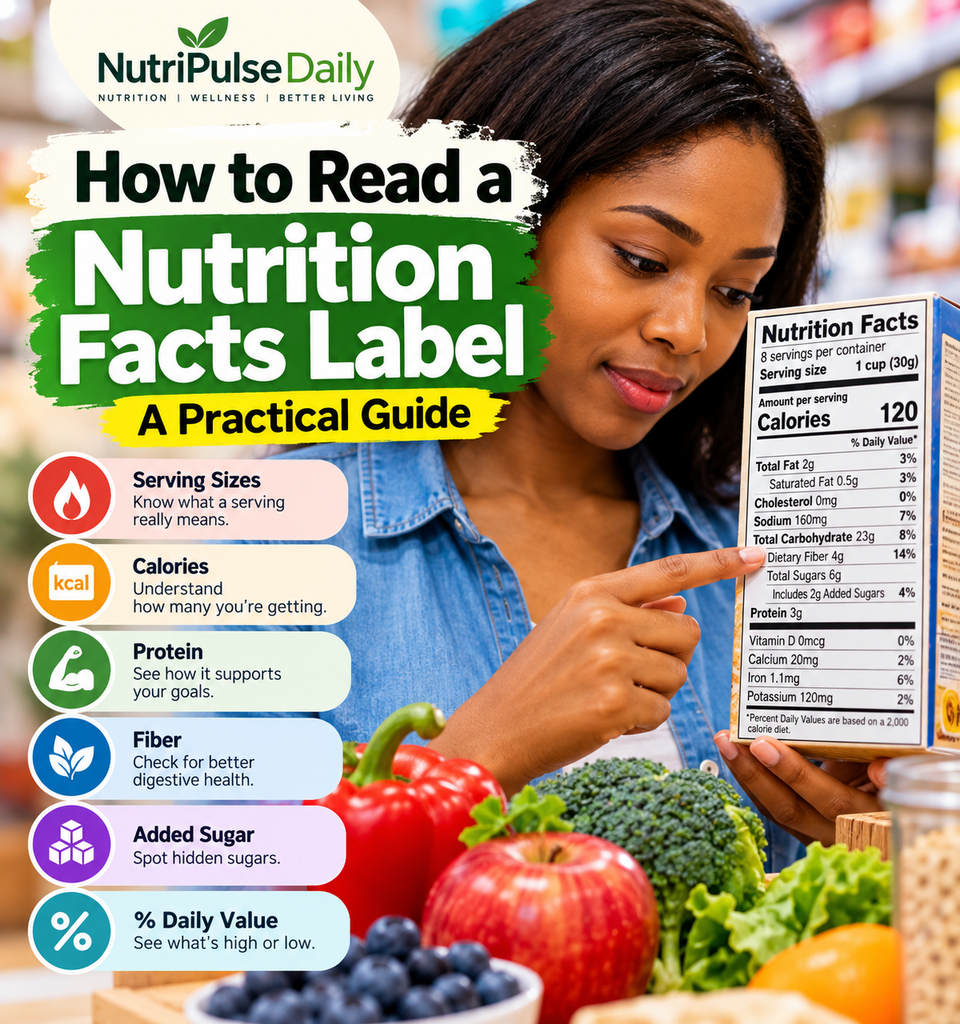
Learning how to read a nutrition label helps you make informed food choices and understand what you’re eating. Nutrition Facts labels show important details such as serving size, calories, fat, carbohydrates, fiber, protein, sodium, and added sugars.
However, knowing what the numbers mean is just as important as seeing them. A product may appear healthy based on one nutrient while containing a large amount of added sugar, sodium, or calories.
Learning how to read a Nutrition Facts label can help you compare similar products, understand your portions, and choose foods that better fit your nutrition and weight-management goals.
In this guide, we’ll walk through the main parts of a Nutrition Facts label and explain what to look for when choosing foods.
How to Read a Nutrition Label: Understanding the Key Sections
A Nutrition Facts label is the standardized nutrition information found on packaged foods and beverages in the United States. It helps you understand how much energy and which nutrients a food provides.
The label typically includes information about serving size, calories, total fat, saturated fat, carbohydrates, fiber, sugars, added sugars, protein, sodium, vitamins, and minerals.
The information is based on a specific serving size, so understanding the serving size is an important first step. The amount you actually eat may be more or less than one serving, which means your calorie and nutrient intake may also be different from the amounts listed on the label.
Nutrition Facts labels can be especially useful when comparing similar products. Looking beyond calories alone and considering nutrients such as fiber, protein, saturated fat, sodium, and added sugar can give you a better picture of a food’s nutritional value.
Start With the Serving Size
The serving size is one of the first things you should check on a Nutrition Facts label. It tells you the amount of food or drink that the nutrition information is based on.
For example, a package may contain two servings, even though you might consider the entire package to be one portion. If you eat the whole package, you may consume twice the calories, fat, sugar, protein, and other nutrients listed for one serving.
Also check the servings per container. This tells you how many servings are contained in the entire package.
When comparing products, make sure you compare similar serving sizes. A product may appear lower in calories or sugar simply because its listed serving size is smaller.
Practical tip: Before looking at the calories or other nutrients, ask yourself: “How much of this food am I actually going to eat?” Then use the label to estimate what you’re really consuming.
Check the Calories
Calories tell you how much energy a food provides per serving. The calorie number on the Nutrition Facts label applies to one serving, not necessarily to the entire package.
For example, if a package contains two servings and each serving has 200 calories, eating the entire package would provide 400 calories.
When you’re trying to manage your weight, calories can be useful because regularly consuming more energy than your body needs can contribute to weight gain. However, calories shouldn’t be considered in isolation. The nutritional quality of the food and the amounts of nutrients such as protein and fiber also matter.
When checking calories:
- Look at the serving size first.
- Check how many servings you actually plan to eat.
- Multiply the listed calories by the number of servings you consume.
- Compare similar foods using the same serving size whenever possible.
Practical tip: Don’t automatically assume that a food with fewer calories is the healthier choice. Check the rest of the Nutrition Facts label to see what you’re getting for those calories.
Understand Total Fat, Saturated Fat and Trans Fat.
Fat is an essential nutrient that provides energy and helps the body perform important functions. However, the type and amount of fat in a food can matter when you’re building a balanced eating pattern.
The Nutrition Facts label separates fat into different categories:
- Total Fat: This includes all types of fat in one serving of the food.
- Saturated Fat: Found in foods such as fatty meats, butter, cheese, and some baked foods. Eating too much saturated fat can make it harder to maintain a heart-healthy eating pattern.
- Trans Fat: Trans fat can occur naturally in small amounts in some foods, but industrially produced trans fat is particularly important to limit. Check the label when comparing packaged foods.
When comparing similar products, look at saturated fat and trans fat, rather than focusing only on total fat. A food that contains fat isn’t automatically unhealthy, since foods such as nuts, seeds, fish, and some plant oils can provide beneficial unsaturated fats.
Practical tip: Don’t avoid all fats simply because you’re watching your calories. Instead, consider the type of fat, portion size, and overall nutritional quality of the food.
Look at Carbohydrates, Fiber and Total Sugars
Carbohydrates are one of the main sources of energy in your diet. On the Nutrition Facts label, Total Carbohydrate includes sugars, starches, and fiber.
When checking carbohydrates, pay particular attention to dietary fiber and total sugars.
- Dietary Fiber: Fiber is a type of carbohydrate that the body does not fully digest. Foods rich in fiber, such as beans, lentils, fruits, vegetables, and whole grains, can help support digestive health and may help you feel full for longer.
- Total Sugars: This includes both naturally occurring sugars and added sugars in the food.
- Total Carbohydrate: This represents the overall amount of carbohydrate in one serving, including fiber and sugars.
A food containing carbohydrates isn’t automatically unhealthy. The source and overall nutritional quality matter. For example, fruit and whole grains provide carbohydrates along with other nutrients, while many highly processed foods may provide substantial carbohydrates with fewer beneficial nutrients.
Practical tip: When comparing carbohydrate-containing foods, look for options that provide more fiber and less added sugar while fitting your overall eating pattern.
Check Added Sugars
Added sugars are sugars that are added to foods or beverages during processing, preparation, or packaging. They are different from the sugars that naturally occur in foods such as fruit, vegetables, and plain milk.
The Nutrition Facts label lists Added Sugars separately from Total Sugars, making it easier to see how much sugar has been added to a product.
The FDA uses a Daily Value of less than 50 grams of added sugars per day based on a 2,000-calorie diet. Your individual needs may be different depending on your overall calorie intake and dietary needs.
When comparing packaged foods, check the Added Sugars line rather than looking only at Total Sugars. A product may contain natural sugars without having much or any added sugar.
Practical tip: If two similar products have comparable calories, consider choosing the one with less added sugar and more beneficial nutrients such as fiber or protein.
Pay Attention to Protein
Protein is an essential nutrient that helps your body build and maintain muscles and other tissues. It can also contribute to feelings of fullness, making protein an important part of a balanced eating pattern.
The Nutrition Facts label shows the amount of protein per serving. When comparing foods, consider both the protein amount and the overall nutritional quality of the food.
Good protein sources can include fish, poultry, eggs, beans, lentils, nuts, seeds, dairy products, and soy foods. Some packaged foods may also be fortified with protein, but a higher protein number does not automatically make a product healthier.
If you’re trying to manage your weight, foods that provide protein along with other beneficial nutrients can help you build more satisfying meals.
Practical tip: Check the protein amount together with calories, fiber, saturated fat, and added sugar rather than choosing a product based on protein alone.
What Does % Daily Value Mean?
The % Daily Value (%DV) tells you how much a nutrient in one serving contributes to the daily amount recommended for a typical 2,000-calorie diet.
It can help you quickly judge whether a food contains a little or a lot of a particular nutrient.
As a general guide:
- 5% DV or less is considered low.
- 20% DV or more is considered high.
For nutrients you may want more of, such as fiber, a higher %DV can be useful. For nutrients you may want to limit, such as saturated fat, sodium, and added sugars, a lower %DV is generally preferable.
Remember that %DV is a general guide, not a personalized recommendation. Your individual nutritional needs can vary depending on factors such as age, sex, activity level, and health circumstances.
Practical tip: Use %DV to compare similar products and quickly identify which options are higher or lower in specific nutrients.
How to Compare Two Similar Products
Nutrition Facts labels become especially useful when you’re deciding between two similar foods. Instead of looking at only one number, compare several key nutrients using the same serving size.
For example, when comparing two breakfast cereals, you might check:
- Calories: Which provides fewer calories per comparable serving?
- Fiber: Which provides more dietary fiber?
- Protein: Which provides more protein?
- Added Sugar: Which contains less added sugar?
- Saturated Fat: Which contains less saturated fat?
- Sodium: Which contains less sodium?
Also check the serving size before comparing the numbers. If one product lists a smaller serving, its calories and nutrients may appear lower simply because you’re comparing different amounts of food.
The better choice isn’t necessarily the product with the lowest calories. Consider the overall nutritional profile and choose the option that better fits your dietary needs and goals.
Practical tip: When comparing products, look beyond the front of the package. The Nutrition Facts label gives you a more useful basis for making an informed choice.
Common Mistakes When Reading Food Labels
Nutrition Facts labels can be helpful, but it’s easy to misinterpret the information. Avoiding a few common mistakes can help you make better comparisons and understand what you’re actually eating.
1. Ignoring the serving size
One of the most common mistakes is assuming the entire package represents one serving. Always check the serving size and servings per container before interpreting the numbers.
2. Looking only at calories
Calories are important, but they don’t tell you everything about a food. Also consider protein, fiber, added sugar, saturated fat, and sodium.
3. Confusing total sugar with added sugar
Total sugars include both naturally occurring and added sugars. Check the Added Sugars line to see how much sugar has been added to the product.
4. Assuming “low-fat” means healthy
A low-fat product isn’t automatically a healthier choice. Some products may contain significant amounts of added sugar or sodium.
5. Comparing products with different serving sizes
Always compare similar serving sizes. Otherwise, one product may appear healthier simply because its listed serving is smaller.
6. Relying only on the front of the package
Words such as “natural,” “light,” or “healthy” can give you a quick impression, but the Nutrition Facts label provides more useful information for comparing products.
Practical tip: Take a few seconds to check the serving size, calories, fiber, protein, added sugar, saturated fat, and sodium before deciding between similar products.
How to Use Nutrition Labels for Weight Management
Nutrition Facts labels can be useful when you’re trying to manage your weight because they help you understand how many calories and nutrients you’re getting from packaged foods.
Start by checking the serving size and calories. If you eat more than one serving, remember that the calories and nutrients increase accordingly.
Next, look at the overall nutritional profile. Foods that provide protein and fiber can help make meals more satisfying, while keeping an eye on added sugars, saturated fat, and sodium can help you make choices that fit a balanced eating pattern.
You don’t have to avoid every food that is higher in calories or sugar. Instead, use the label to compare options and make choices that fit your overall eating pattern and calorie needs.
Nutrition labels are particularly useful when shopping because they allow you to compare similar products and choose options that better support your weight-management goals.
Practical tip: Don’t focus on one number. Consider serving size, calories, protein, fiber, added sugar, and saturated fat together when deciding which product fits your needs.
Frequently Asked Questions
What is the most important part of a Nutrition Facts label?
Start with the serving size, because all the nutrition information on the label is based on that amount. Then check calories and the nutrients that are most relevant to your goals, such as protein, fiber, added sugar, saturated fat, and sodium.
How do I know if a food is high in added sugar?
Check the Added Sugars line on the Nutrition Facts label. You can also use the % Daily Value as a quick guide when comparing similar products.
Is a food with more calories always unhealthy?
No. Calories are only one part of a food’s nutritional profile. Consider the food’s protein, fiber, fats, sugars, vitamins, minerals, and overall quality when making your choice.
What does 20% Daily Value mean?
A %DV of 20% or more is generally considered high, while 5% or less is considered low. This can help you quickly compare the amount of a particular nutrient in different foods.
Should I avoid carbohydrates when trying to lose weight?
Not necessarily. Carbohydrates are an important source of energy. Instead of avoiding them completely, focus on nutritious carbohydrate sources such as fruits, vegetables, beans, lentils, and whole grains, while considering your overall calorie and nutrient intake.
Do I need to count calories to manage my weight?
Not necessarily. Calorie counting can be useful for some people, but you can also focus on appropriate portions and a balanced eating pattern that includes nutritious foods. The approach that is practical and sustainable for you is often more useful than relying on a single method.
Bottom Line
Learning how to read a Nutrition Facts label can make it easier to understand what you’re buying and eating. Start with the serving size, then look at calories and important nutrients such as protein, fiber, added sugar, saturated fat, and sodium.
Rather than focusing on a single number, consider the overall nutritional profile of the food and how it fits into your daily eating pattern. Comparing similar products using their Nutrition Facts labels can also help you make more informed choices.
You don’t need to make every food choice perfect. The goal is to use nutrition information as a practical tool for building a balanced, sustainable eating pattern that supports your overall health and, when appropriate, your weight-management goals.
References
U.S. Food and Drug Administration (FDA) — Added Sugars on the Nutrition Facts Label
U.S. Food and Drug Administration (FDA) — How to Understand and Use the Nutrition Facts Label
National Institute of Diabetes and Digestive and Kidney Diseases (NIDDK) — Health Tips for Adults
U.S. Department of Agriculture (USDA) — MyPlate
Centers for Disease Control and Prevention (CDC) — Healthy Eating Tips